Theme year 2017: People and the environment

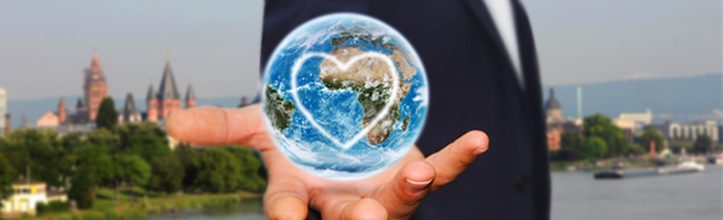
The theme year focused on the diverse interactions between humans and their environment. Shaping these interactions in a productive way has always been one of humanity's greatest challenges. For science and research, it is one of the key tasks for the future.
Numerous institutions in and around Mainz are concerned with the sustainable development and shaping of the relationship between humans and their environment, or are developing solutions and products that enable us to live healthy lives in an environment worth living in. A number of scientific institutions and projects in the region are helping to drive these developments forward and reflect on them.
However, the theme year also conveyed key points of the city's agenda on the topic of "humans and the environment." The activities of the theme year took up these key points, brought them into scientific and public discourse, and supported the presence of this agenda in the public perception.
Why in Mainz?
The Anthropocene epoch was established in Mainz
In geological terms, we are currently in the Holocene epoch, which began around 11,000 years ago. However, in 2000, Nobel Prize winner in Chemistry Paul Crutzen coined the term "Anthropocene" to express the idea that our actions are crucial to the future development of our planet. The Anthropocene views humans as a factor that irrevocably changes the geological, biological, and atmospheric processes on Earth.
Examples of how strongly humans influence the environment on a global scale include climate change, species extinction, and ocean pollution. Even though the term is still hotly debated among geologists, it has become an integral part of science and society. Numerous research approaches in the natural sciences and humanities are now devoted to this conceptual idea, which can be further developed and compared to the term "Future Earth."
Nobel Prize winner Paul Crutzen worked in Mainz for many years. From 1980 to 2000, he was director of the Max Planck Institute for Chemistry in Mainz and received the Nobel Prize in Chemistry in 1995 for his work in the field of atmospheric chemistry.