
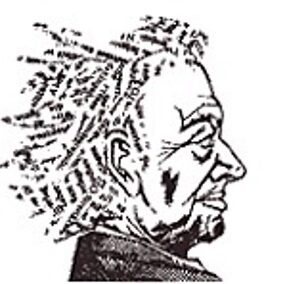
Victor Otto Stomps - V.O. Stomps
Exceptional small-scale publishing or special achievements in book design or literature are the criteria set out in the preamble to the guidelines, which serve as the basis for assessing applicants for the V.O. Stomps Prize.
Victor Otto Stomps (1897–1970), known to his friends as VauO, was committed to these criteria. He is considered the father of small publishers and mini-presses. He combined the traditions of self-publishing and private presses. He realized his ideas about literature and book design mainly in three publishing houses.
Vita
In 1925, at the age of 28, Stomps bought his first used platen press and, together with two friends, manually printed "poetry in small, narrow booklets" in Berlin-Friedenau. This was the origin of his first publishing house, which he named "Rabenpresse" (Raven Press). "The beginning of my 'Rabenpresse' was a protest against what the motor creates: the huge print runs that exclude the obscure. It started with a hand press. Gebser and I had bought this machine and didn't know how to use it. We couldn't get a decent print. We consoled ourselves with a bottle—and with every shot of schnapps, its outline seemed more like a ghostly raven to us—the hand lever like a wing poised to strike." (V.O.Stomps: Gelechter. Frankfurt am Main. 1962)
Raven press
In the early 1930s, Rabenpresse was the publishing house in Germany that attracted young poets. Stomps, the publisher, championed his authors in an increasingly volatile political climate, even putting himself at risk.
World War II made it impossible for Rabenpresse to continue. "He never allowed himself to be guided by considerations that lay outside his artistic insight." (G.B. Fuchs/Harry Pross (eds.): guten morgen vauo. p. 23; Frankfurt: 1962)
Hermit Press
Shortly after his release from captivity, he began working with Eremiten-Presse. Here, too, he once again acted as publisher "for the young." The publishing program was dominated by texts that other publishers did not dare to publish. In 1954, Eremiten-Presse moved to Stierstadt in the Taunus region, into an old half-timbered house that Stomps called "Schloss Sanssouris."
Stomps lived and worked there with his publishing house staff. Authors were also included in this living and working community by living in Stierstadt for a while and setting, printing, and binding their books themselves. As a writer, V.O. Stomps dealt with various forms of expression. In addition to poems, epigrams, essays, and a novel, his fables are among his most original literary productions.
Theodor Fontane Literature Prize
In 1965, he received the Theodor Fontane Literature Prize from the City of Berlin. "His work is living testimony to an inner necessity. His poetic idiosyncrasies arose from real psychological conflicts and cannot be separated from his literary qualities." (guten morgen vauo p. 59) Both as a publisher and as a writer, Stomps promoted spaces of freedom in which artistic and intellectual life could flourish in the first place.
With his publishing houses, he attempted to create such spaces on a small scale. Financial profitability never played a role for Stomps in his publishing work; on the contrary, he had to accept outside printing orders to finance his publishing projects and his livelihood.
New raven press
After breaking with Eremiten-Presse in 1967, he returned to Berlin and opened the "Neue Rabenpresse" at the age of 70. Looking back, he can look back on over forty years of publishing with 300 authors and books. Stomps died in 1970 – in poverty. The books published by V.O. Stomps are remarkable in many ways: both their form and content are characterized by the courage and curiosity to try new things.
Whether in terms of new techniques, ingenuity in typography, or the promotion of new young authors. Innovation and the drive for the unprecedented were characteristic of Stomps as a person.
V.O. Stomps Prize
In this sense, the award-winning works should be linked to the work of V.O. Stomp "in terms of content, intention, and personal commitment. These may be significant individual editions or the entire oeuvre of a publisher, graphic artist, or writer."