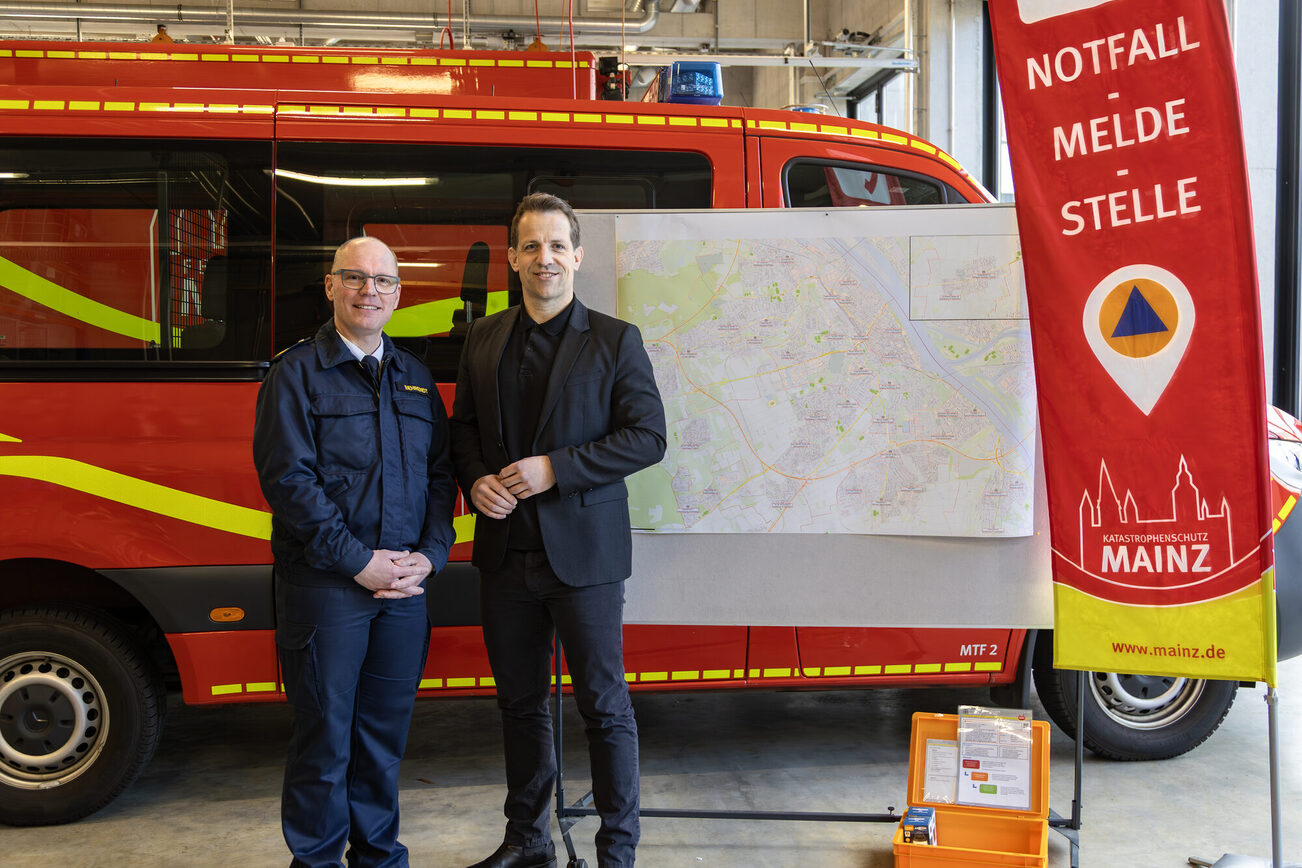
When the emergency call fails: State capital Mainz sets up emergency call centers
The state capital of Mainz has developed a comprehensive concept to ensure emergency care in the event of critical infrastructure failures. At the heart of the concept are so-called emergency notification centers (NMS), which serve as contact points for the population in the event of an emergency.
A total of 39 mobile and stationary emergency reporting stations (opens in a new tab) are planned for the city area. These can be put into operation and staffed simultaneously, ensuring that there is a reporting station within a one-kilometer radius where emergency calls can still be made.
The locations were deliberately chosen to be easily accessible to the public, including volunteer fire department stations, ambulance stations, police stations, and select well-known public places such as supermarkets or pharmacies. The emergency reporting stations are appropriately marked and equipped. They serve to receive emergency reports and relay them via radio to the control centers in the event that telephone and mobile networks fail. “With the emergency reporting centers, we are creating a reliable structure for the people of Mainz in extraordinary situations. Our goal is to ensure that help can be reached even under difficult conditions,” explains Mayor Nino Haase.
It is important to clearly define their function: The emergency reporting centers are intended solely for receiving and relaying emergency calls.
“The emergency call centers are not supply centers. They are not intended to provide the population with electricity or other resources, for example, but solely to ensure that emergency calls can be made,” emphasizes Stefan Behrendt, Fire and Disaster Protection Inspector.
Personal preparedness plays a crucial role in such situations. “Households that can be self-sufficient for at least 72 hours in an emergency provide significant relief for everyone involved,” emphasizes Behrendt. “This allows emergency responders to focus their efforts on people who need immediate assistance while also restoring critical infrastructure more quickly.”
Basic preparedness includes, among other things, sufficient drinking water, non-perishable food, necessary medications, and a battery-powered or hand-crank radio that, ideally, can also be used as a charger for a cell phone. Further information is provided by the Federal Office for Civil Protection and Disaster Assistance: Guide: Preparing for Crises and Disasters (opens in a new tab).
The implementation of emergency reporting centers is carried out in close cooperation with various organizations, including the fire department, aid organizations, the police, and other authorities. The equipment includes, among other things, radios, spare batteries, and standardized reporting forms.
With this concept, the city of Mainz is responding to potential scenarios such as widespread power outages or disruptions to communication networks and is specifically strengthening its crisis resilience.
The emergency reporting centers will be appropriately marked and equipped as needed.
The goal of the concept is to ensure rapid and structured emergency communication even under extraordinary conditions.