Presentation of funding contract: 397,000 euros from the DSD for the Electoral Palace
Mayor Haase: "The German Foundation for Monument Protection has been a reliable and close partner in the preservation and restoration of the Electoral Palace for many years"
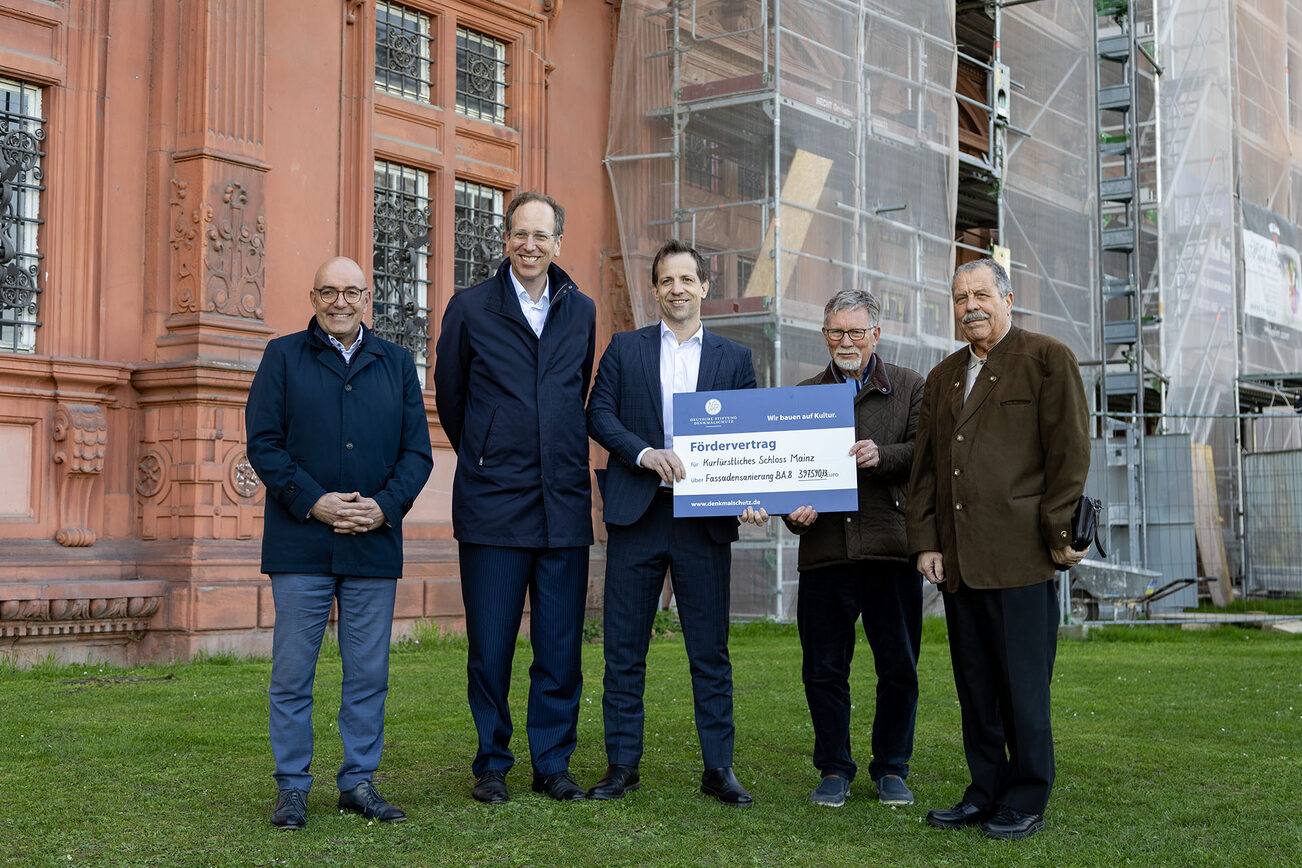
The state capital of Mainz is once again receiving significant support for the preservation of its historic Electoral Palace: The German Foundation for Monument Protection (DSD) is providing 397,000 euros to fund the renovation of additional sections of the facade. The symbolic handover of the grant agreement took place on site at the palace, with Mainz DSD local curator Robert Sommer presenting it to Mayor Nino Haase and Head of the Building Department Ludwig Holle.
The state capital of Mainz is delighted about this renewed funding: “It’s wonderful that the German Foundation for Monument Protection is supporting our Electoral Palace once again. Such contributions are invaluable to us in preserving our ‘Gut Stubb’ as a historic treasure of Mainz,” said Mayor Nino Haase about the major project.
Head of the Building Department Ludwig Holle also emphasizes the significance of the funding agreement: “The restoration of the historic facades is an important contribution to the preservation of our urban cultural heritage—this was already the case back when the local curator was Erika Friedrichs. We are very pleased that the German Foundation for Monument Protection is supporting the restoration once again—for the benefit of our palace and the people of Mainz.”
The DSD has been providing technical and financial support for the renovation work on the Electoral Palace for the eighth time since 2009.
Mayor Nino Haase: "The state capital therefore expressly thanks the DSD for its continued attention to this beautiful but dilapidated building in the heart of our city."
With the current grant and earmarked donations from the Mainz Monument Network, the total support, including the current grant, now amounts to over 2.7 million euros.
DSD Regional Curator Robert Sommer presented the grant agreement in front of the Electoral Palace in Mainz. He emphasized the importance of the support for the renovation of the historic building: "For many years, the German Foundation for Monument Protection has been supporting the renovation of this special building. I am therefore all the more pleased to present you today with this grant agreement for 397,000 euros—as a joint contribution to preserving the Electoral Palace as a living testament to Mainz’s history."
The current facade renovation includes, among other things:
- Repair and replacement of damaged natural stone sections
- Removal and reapplication of plaster surfaces
- Replacement of windows
- Restoration of metal window grilles.
Mainz Castle is one of over 360 properties in Rhineland-Palatinate that the DSD has supported to date. The foundation is the largest private initiative for historic preservation in Germany and is funded, among other things, by donations and the GlücksSpirale lottery.
To the Electoral Palace
Built of red sandstone, the Electoral Palace is one of Germany’s most significant Renaissance structures. Together with the Teutonic Order Commandery (now the State Parliament) and the New Armory (now the State Chancellery), it defines Mainz’s prestigious Rhine waterfront. The palace is the city’s most important secular building, a structure of national significance. Construction began in 1627 with the Rhine Wing adjacent to Martinsburg and continued over several decades. In the mid-18th century, the two wings were extended, and about 50 years later, the single-story Stone Hall was added. After the demise of the Electorate of Mainz, the palace served as a barracks, military hospital, and customs warehouse in the 19th century. In 1827, the city of Mainz acquired the complex.
During World War II, the palace burned down completely in 1942. During its reconstruction in 1948, the palace was restored, while the interior was fitted out for practical use. In 1990, the exterior façade was reconstructed true to the original. Today, the Electoral Palace serves as an event and conference venue. The large north wing also hosts regular city events, such as the traditional joint meeting of the four carnival clubs, “Mainz bleibt Mainz, wie es singt und lacht” (Mainz remains Mainz, as it sings and laughs).
German Foundation for Monument Protection
The German Foundation for Monument Protection is the largest private initiative for historic preservation in Germany. Since 1985, it has been working creatively, professionally, and independently to preserve endangered historic buildings.
Its holistic approach is unique, ranging from emergency rescue of endangered monuments and educational programs for schools and youth to the nationwide Open Monument Day® campaign.
The foundation supports around 600 projects annually, primarily thanks to the active support and donations of over 200,000 supporters. In total, the German Foundation for Monument Protection has already supported over 7,500 monuments throughout Germany with more than three-quarters of a billion euros. Yet numerous unique historic buildings in Germany remain under acute threat.